陳健生
教授
- 辦公室:生醫卓群 9 樓 13932 室
- 電話:+886-6-2353535 ext 1541
- 傳真:+886-6-2752484
- Email:cschen@gs.ncku.edu.tw
- High Throughput Biosensing Lab:cschen@gs.ncku.edu.tw
- 「高通量蛋白質微陣列技術與生醫產業服務聯盟」https://htpm.web2.ncku.edu.tw/
High Throughput Biosensing Lab
專長與研究領域
- 蛋白質體微陣列晶片
- 宿主-微生物相互作用
- 奈米生醫感測科技
- 食品病原菌檢測
開授課程
上學期開授課程:
NCKU (All in English)
- Biosensing Technology
- Rapid Detection
- Advanced Molecular Biology
下學期開授課程:
NCKU (All in English)
- Food Chemistry
- High Throughput Biomedical Detection Technology
學歷與經歷
學歷
- 2005 – 2007 Postdoc. Department of Pharmacology and Molecular Sciences Johns Hopkins University
- 2001 – 2005 Ph.D. Department of Food Science and Technology Cornell University
- 1996 – 1998 M.S. Graduate Institute of Food Science and Technology National Taiwan University
- 1992 – 1996 B.S. Department of Marine Food Science National Taiwan Ocean University
經歷
Work Experience:
- 2019 Department of Population Medicine and Diagnostic Science College of Veterinary Medicine Cornell University / Visiting Scholar
- 2018 - Department of Food Safety Hygiene and Risk Management National Cheng Kung University / Professor
- 2016 – 2018 Department of Biomedical Science and Engineering Graduate Institute of Systems Biology and Bioinformatics National Central University / Professor
- 2017 Department of Chemistry and Chemical Biology Cornell University / Visiting Scholar
- 2015 – 2017 Graduate Institute of Systems Biology and Bioinformatics Director Department of Biomedical Science and Engineering, National Central University / Vice chair
- 2012 – 2016 Graduate Institute of Systems Biology and Bioinformatics, National Central University / Associate Professor
- 2008 – 2012 Graduate Institute of Systems Biology and Bioinformatics, National Central University / Assistant Professor
- 2008 – 2011 Department of Health, Executive Yuan, Taiwan / Food Safety Consultant
- 2007 – 2008 Department of Food Science, National Taiwan Ocean University / Assistant Professor
- 2005 – 2007 High Throughput Biology Center, Johns Hopkins University / Postdoctoral fellow
Teaching Experience
Cornell University
- Graduate Teaching Assistant of FOOD 396 Food Safety Assurance
NTOU
- Food Chemistry
- Molecular Biology
- Biochemistry
- Biosensing Technology
NCU (All in English)
- High Throughput Biomedical Science and Technology
- Proteome Microarray Technology
- Biosensing Technology
- Biochemistry and Molecular Biology
- High Throughput Biosensing Technology
- Special topic: Protein Microarray
- Amino Acid and Protein
- Systems Biology
NCKU (All in English)
- Food Chemistry
- Biosensing Technology
- Rapid Detection
- High Throughput Biomedical Detection Technology
- Advanced Molecular Biology
Professional Services
- Council member of Taiwan Proteomics Society
- Council member of Taiwan Society Developmental Origins of Health and Disease
- Academic editor for PLoS One
- Associate editor for Journal of Integrated OMICS
- Editorial board member for Journal of Translational Proteomics Research
- Editorial board member of SM Journal of Bioinformatics and Proteomics
- Session chair for World Gene Convention-2013 and PepCon 2014
- Scientific and local organizing committee member for Human Proteome Organization World Congress 2016
- The Secretary-general for the 8th Asian Oceania Human Proteome Organization Congress
- Grant proposal reviewers for Austrian Science Fund, Hong Kong Innovation and Technology Support Programme and Taiwan National Science Council
- Manuscript reviewers for Analytical and Bioanalytical Chemistry, PLoS One, Journal of Proteomics Research, Bioanalysis, Molecular & Cellular Proteomics and Biosensors & Bioelectronics
榮譽及獎勵
- 2024 President, Taiwan Proteomics Society 台灣蛋白體學會理事長
- 2023 National Innovation Excelsior Award, Taiwan國家新創精進獎
- 2022 National Innovation Award, Taiwan 國家新創獎
- 2021 National Innovation Award, Taiwan 國家新創獎
- 2018 National Innovation Award, Taiwan 國家新創獎
- 2017-2019 Distinguished Professor, National Central University 特聘教授
- 2014-2016 Distinguished professor, National Central University
- 2013 Academia Sinica Research Award for Junior Research Investigators 中央研究院年輕學者研究著作獎
- 2013 Award for Excellent Contributions in Technology Transfer, National Central University
- 2013 Outstanding research award, National Central University
- 2013 Career Development Grant award, National Health Research Institutes
- 2008 Outstanding new faculty award, National Central University
專利
Patent
- ASSAY KIT AND ANALYSIS METHOD, Taiwan I472369 (20150211-20320723)
Technology Transfer
- Collagen peptide production, 2012, F.C. BIOTECHNOLOGY CO., LTD
著作
- Yang J.-Y., Chen Y.-Z., Tsai R.-Y., Chen R.-P., Hsieh L.-F., Chang T.-H., Chen C.-S*. (2024, Dec). Development of multiple genome-wide proteome microarrays comprised wafer substrate-based chip and its scanner: An advanced high-throughput and sensitivity for molecular interactions studies. Biosensors and Bioelectronics. Pages 117110.
- Lin, C. C., Chen, C. S*. (2024, Dec). Bacterial Proteome Microarray Technology in Biomedical Research. Trends in Biotechnology. (Accepted).
- Yang, T. H., Syu, G. D., Chen, C. S., Chen, G. R., Jhong, S. E., Lin, P. H., Lin, P. C., Wang, Y. C., Shah, P., Tseng, Y. Y. & Wu, W. S. BAPCP: A comprehensive and user-friendly web tool for identifying biomarkers from protein microarray technologies. (2024, Sep) Computer Methods and Programs in Biomedicine. 254, 108260. Co-first author.
- Herianto S., Subramani B., Chen B.-R., Chen C.-S*. Recent advances in liposome development for studying protein-lipid interactions. (2024) Critical Reviews in Biotechnology, 44(1):1-14.
- Keskin, B. B., Chen, C. S., Tsai, P. S., Du, P. X., Santos, J. H. M. & Syu, G. D. Reverse-Phase Protein Microarrays for Overexpressed Escherichia coli Lysates Reveal a Novel Tyrosine Kinase. (2024 May) Analytical Chemistry. 96, 21, p. 8721-8729 9 p.
- Ahmadi AR, Song G, Gao T, Ma J, Han X, Hu M-W, Cameron AM, Wesson RN, Philosophe B, Ottmann S, King E, Gurakar A, Qi L, Peiffer B, Burdick J, Anders R, Zhou Z, Lu H, Feng D, Chen C-S, Qian J, Gao B, Zhu H, Sun Z* .(2023, Dec) Discovery and characterization of cross-reactive intrahepatic antibodies in severe alcoholic hepatitis. elife12:RP86678.
- Chen, YC., Hsu, JY., Chen, C-S., Chen, YT. & Liao, PC*.(2023, Jun) Development of a lateral flow immunoassays-based method for the screening of ractopamine in foods and evaluation of the optimal strategy in combination of screening and confirmatory tests. Journal of Food and Drug Analysis. 31, 2, p. 289-301.
- Syu GD*, Reymond Sutandy FX, Chen K, Cheng Y, Chen C-S*, Shih JC*. (2023, Jan) Autoantibody Profiling of Monoamine Oxidase A Knockout Mice, an Autism Spectrum Disorder Model. Brain, Behavior, and Immunity. 107:193‐200.
- Chen, B.-Y., Hsu, C.-C., Chen, Y.-Z., Lin, J.-J., Tseng, H.-H., Jang, F.-L., Chen, P.-S., Chen, W.-N., Chen, C.-S*., Lin, S.-H*. (2022, Nov) Profiling antibody signature of schizophrenia by Escherichia coli proteome microarrays. Brain, Behavior, and Immunity. 106:11-20.
- Rathod J, Yen C-H, Liang B-Q, Tseng Y-Y, Chen C-S* and Wu W-S*(2021, Jun). YPIBP: A repository for phosphoinositide-binding proteins in yeast. Computational and Structural Biotechnology Journal.19: 3692-3707.
- Shah P and Chen C-S* (2021, Jan.). Systematic identification of protein targets of Sub-5 using Saccharomyces cerevisiae proteome microarrays. International Journal of Molecular Sciences. 22(2):760.
- Herianto S, Rathod J Shah P, Chen Y-Z, Wu W-S, Liang B, Chen C-S* (2021, Jan.). Systematic analysis of phosphatidylinositol-5-phosphate-interacting proteins using yeast proteome microarrays. Analytical Chemistry. 93(2) 868–877.
- Shah P and Chen C-S* (2020, Dec). Systematic identification of protein targets of Sub-5 using Saccharomyces cerevisiae proteome microarrays. International Journal of Molecular Sciences. 22(2):760.
- Hsu P-C, Chen C-S*, Wang S, Hashimoto1 M, Huang W-C and Teng C-H* (2020, Aug). Identification of MltG as a Prc Protease Substrate Whose Dysregulation Contributes to the Conditional Growth Defect of Prc-Deficient Escherichia coli. Front. Microbiol., doi: 10.3389/fmicb.2020.02000. co-first author
- Hsiao FS-H, Yang S-K, Lin J-M, Chen Y-W, Chen C-S* (2019, Sep). Protein interactome analysis of iduronic acid-containing glycosaminoglycans reveals a novel flagellar invasion factor MbhA. Journal of Proteomics. 208:103485.
- Shah P, Wu W-S, Chen C-S* (2019, Sep). Systematical Analysis of the Protein Targets of Lactoferricin B and Histatin-5 Using Yeast Proteome Microarrays. International Journal of Molecular Sciences. 20(17):4218.
- Chien F-C, Lo J-L, Zhang X, Cubukcu E, Luo Y-T, Huang K-L, Tang X, Chen C-S*, Chen C-C, Lai K-Y (2018, Oct). Nitride-Based Microarray Biochips: A New Route of Plasmonic Imaging. ACS Appl. Mater. Interfaces, 10 (46), 39898–39903.
- Feng Y, Chen C-S, Ho J, Pearce D, Hu S, Wang B, Desai P, Kim KS, Zhu H (2018, Sep). High-Throughput Chip Assay for Investigating Escherichia coli Interaction with the Blood–Brain Barrier Using Microbial and Human Proteome Microarrays (Dual-Microarray Technology). Analytical Chemistry 90(18):10958-10966.
- Hsu T-Y, Lin J-M, Nguyen MT, Chung F-H, Tsai C-C, Cheng H-H, Lai Y-J, Hung H-N, Chen C-S*. (2018) Antigen Analysis of Pre-Eclamptic Plasma Antibodies Using Escherichia coli Proteome. Molecular & Cellular Proteomics. 17 (8) 1457-1469.
- Kuo HC, Huang YH, Chung FH, Chen PC, Sung TC, Chen YW, Hsieh KS, Chen C-S*, Syu GD* (2018, Mar). Antibody Profiling of Kawasaki Disease Using Escherichia coli Proteome Microarrays. Molecular & Cellular Proteomics. 17(3):472-481.
- Yang A-M, Inamine T, Hochratch K, Chen P, Wang L, Izquierdo CL, Bluemel S, Hartman P, Xu j, Koyama Y, Kisseleva T, Torralba M, Moncera K, Beeri K, Chen C-S, Freese K, Hellerbrand C, Lee S, Hoffman HM, Mehal W, Garcia-Tsao G, Mutlu E, Keshavarizian A, Brown G, Ho SB, Bataller R, Starkel P, Fouts D, Schnabl B. (2017, Jun). Intestinal fungi contribute to development of alcoholic liver disease. Journal of Clinical Investigation, 127(7):2829-2841. (SCI, 3/140 MEDICINE, RESEARCH & EXPERIMENTAL ). MOST 104-2320-B-006-053-MY3.
- Huang B-Y, Chen P-C, Chen B-H, Wang C-C, Liu H-F, Chen Y-Z, Chen C-S*, Yang Y-S* (2017, Mar). High-throughput screening of sulfated proteins by using a genome-wide proteome microarray and protein tyrosine sulfation system. Analytical Chemistry, 89(6):3278-3284. (SCI, 6/98, Chemistry, Analytical). MOST 104-2320-B-006-053-MY3.
- Tsai C-H, Ho Y-H, Sung T-C, Wu W-F, Chen C-S* (2016, Nov). E. coli proteome microarrays identified the substrates of ClpYQ protease. Molecular & Cellular Proteomics, 16(1):113-120. (SCI, 8/78, Biomedical Research Methods).
- Lin J-M, Tsai Y-T, Liu Y-H, Lin Y, Tai H-C*, Chen C-S* (2016, Sep). Identification of 2-oxohistidine interacting proteins using E. coli proteome chips. Molecular & Cellular Proteomics. Molecular and Cellular Proteomics, 15 (12), 3581-3593. (SCI, 8/78, Biomedical Research Methods). MOST 104-2320-B-008-002-MY3.
- Ho Y-H, Shah P, Chen Y-W, Chen C-S* (2016, Jun). Systematic analysis of intracellular targeting antimicrobial peptides Bac 7, PR-39, P-Der and Lfcin B, using E. coli proteome microarrays. Molecular & Cellular Proteomics, 15(6):1837-47. (SCI, 8/78, BIOCHEMICAL RESEARCH METHODS). MOST 103-2627-M-008-001.
- Hsiao F S-H, Sutandy F.X.R, Syu G-D, Chen Y-W, Lin J-M, Chen C-S* (2016, Jun). Systematic protein interactome analysis of glycosaminoglycans revealed YcbS as a novel bacterial virulence factor. Scientific Reports, 6:28425. (SCI, 17/72, MULTIDISCIPLINARY SCIENCES). MOST 104-2320-B-008-002-MY3.
- Shah P, Hsiao F S-H, Ho Y-H, Chen C-S* (2016, Feb). The proteome targets of intracellular targeting antimicrobial peptides. Proteomics, 16(6), 1225-37. (SCI, 23/78, BIOCHEMISTRY & MOLECULAR BIOLOGY ). MOST 103-2627-M-008-001.
- Sung T-C, Chen Y-W, Shah P, Chen C-S* (2016, Feb). A replaceable liposomal aptamer for the ultrasensitive and rapid detection of biotin. Scientific reports, 6, 21369. (SCI, 17/72, MULTIDISCIPLINARY SCIENCES). MOST 103-2627-M-008-001.
- Chen PC, Syu GD, Chung KH, Ho YH, Chung FH, Chen PH, Lin JM, Chen YW, Tsai SY*, and Chen C-S* (2015, Mar). Antibody Profiling of Bipolar Disorder using Escherichia coli Proteome Microarrays. Molecular & Cellular Proteomics,14(3):510-8.
- Chen YW, Teng CH, Ho YH, Ho TYJ, Huang WC, Hashimoto M, Chiang IY, and Chen C-S* (2014, Jun). Identification of bacterial factors involved in type 1 fimbria expression using an Escherichia coli K12 proteome chip. Molecular & Cellular Proteomics, 13(6):1485-94.
- Chen C-S, Korobkova E, Chen H, Zhu J, Jian X, Tao S-C, He C*, Zhu H* (2008) A proteome chip approach reveals new DNA base damage recognition activities in Escherichia coli. Nature Methods 5: 69-74.
研究成果
My research has been focused on human-microbe interaction, especially systematical analysis of E. coli proteome interaction. My lab has a novel high-throughput protein purification technique to purify ~4800 E. coli proteins. These proteins were then spotted onto various glass surfaces to form high-density proteome array chips, which allow us to develop all kinds of assays for proteome interactions, including nucleic acid-, peptide-, human cell-, lipid-, small molecule drug-, carbohydrate-, and plasma-E. coli proteome interactions. For example, my research team used the Escherichia coli proteome microarray to systematically identify the protein targets of four intracellular targeting AMPs: lactoferricin B, bactenecin 7, a hybrid of pleurocidin and dermaseptin, and proline-arginine-rich peptide. By analyzing their specific target proteins, we revealed their target similarity and differences. We further predicted the synergistic effects between peptides and got successful validation. We also discovered that lactoferricin B inhibits the phosphorylation of the two-component system response regulators. This is the first study to show that an antimicrobial peptide inhibits the growth of bacteria by influencing the phosphorylation of TCS directly.
In addition to the host peptide-microbial proteome interaction study, we also systematically analyzed the protein interactome of four human glycosaminoglycans, which are responsible for the bacterial invasion. We further identified a novel bacterial virulence factor YcbS, which bound to the laminin-binding site of heparin with a high affinity, causing displacement of heparin from laminin to affect the host extracellular matrix structure. E. coli proteome microarrays also helped us to identify that YbaB is a novel substrate of ClpYQ protease and Spr is involved in the regulation of type 1 fimbria expression through direct interaction with the invertible element fimS.
We also analyzed the antibody profile of certain disease patients’ plasma using E. coli proteome array chips to identify the distinguished E. coli proteins able to recognize the antibody difference between health controls and patients with certain diseases, including bipolar diseases, Kawasaki disease, Pre-eclampsia disease, and schizophrenia. All the studies mentioned above were published in the prestigious journals: Nature Methods, Brain, Behavior & Immunity and Molecular & Cellular Proteomics.
For the study of E. coli proteome interactions with human cells, we developed a high throughput chip-based cell probing assay to probe with fluorescent live human brain microvascular endothelial cells (HBMEC, which constitute the brain blood barrier). We identified several transmembrane proteins, which are effectively bound to live HBMEC. This study enables rapid, unbiased discovery of pathogen proteins that are involved in pathogen-host interactions for human infectious diseases in a high throughput manner. This technique was published in Analytical Chemistry and we will develop a chip assay based on this method for this proposal.
In summary, we are experienced in using E. coli proteome microarrays for host-microbe interaction studies. We are confident that our proteome microarray techniques will decipher the molecular interactions between UPEC proteins and bladder epithelial cells.
| 序號 | 論文資料 | 1.突破性之創見
2.對學術發展、社會、經濟等面向之影響 |
| 1 | Yang J.-Y., Chen Y.-Z., Tsai R.-Y., Chen R.-P., Hsieh L.-F., Chang T.-H., Chen C.-S*. (2024). Development of multiple genome-wide proteome microarrays comprised wafer substrate-based chip and its scanner: An advanced high-throughput and sensitivity for molecular interactions studies. Biosensors and Bioelectronics. 272, 117110.
|
This research pioneers the development of high-density wafer-based proteome microarrays, offering enhanced sensitivity and uniformity compared to conventional glass substrates. By enabling multiplexed probing and identifying antimicrobial mechanisms, such as indolicidin’s targets in E. coli, this study significantly advances proteomics technologies, fostering academic innovation and promoting biomedical and economic applications in drug discovery. |
| 2 | Yang, T. H., Syu, G. D., Chen, C. S., Chen, G. R., Jhong, S. E., Lin, P. H., … & Wu, W. S. (2024). BAPCP: A comprehensive and user-friendly web tool for identifying biomarkers from protein microarray technologies. Computer Methods and Programs in Biomedicine, 254, 108260. co-first author | This research presents BAPCP, an advanced web-based tool designed to address current limitations in protein chip analysis by integrating diverse normalization methods and tailored filters. By significantly reducing biomarker identification time from weeks to minutes, BAPCP enhances analytical precision, accelerates biomedical research, and fosters academic innovation with substantial societal and economic implications. |
| 3 | Syu, G. D., Sutandy, F. R., Chen, K., Cheng, Y., Chen, C. S*., & Shih, J. C. (2023). Autoantibody profiling of monoamine oxidase A knockout mice, an autism spectrum disorder model. Brain, Behavior, and Immunity, 107, 193-200. | This study reveals distinct autoantibody signatures in MAO A knockout mice using high-density proteome microarrays, linking immune dysfunction to ASD pathology. By identifying brain-targeting and sex organ-enriched autoantibodies, it provides groundbreaking insights into ASD mechanisms, advancing neuroimmunology, enabling biomarker-based diagnostics, and driving societal and economic benefits through innovative translational research. |
| 4 | Chen, B.-Y., Hsu, C.-C., Chen, Y.-Z., Lin, J.-J., Tseng, H.-H., Jang, F.-L., Chen, P.-S., Chen, W.-N., Chen, C.-S*., Lin, S.-H. * (2022, Nov) Profiling antibody signature of schizophrenia by Escherichia coli proteome microarrays. Brain, Behavior, and Immunity. 106:11-20. | This study delves into the antibody profiles of schizophrenia (SZ) patients, shedding light on the impact of bacterial protein antigens on the disorder. It contributes significantly to academic knowledge by unraveling the intricate relationship between antibody responses and adult-onset schizophrenia. The identified proteins could serve as potential biomarkers, opening avenues for earlier diagnosis and targeted interventions. Beyond academia, these findings may have profound implications for society, influencing healthcare strategies and potentially alleviating the societal and economic burden associated with schizophrenia. |
| 5 | Hsu P-C, Chen C-S, Wang S, Hashimoto1 M, Huang W-C and Teng C-H* (2020, Aug). Identification of MltG as a Prc Protease Substrate Whose Dysregulation Contributes to the Conditional Growth Defect of Prc-Deficient Escherichia coli. Front. Microbiol., doi: 10.3389/fmicb.2020.02000. co-first author
|
This report unveils a pioneering approach in understanding microbial proteases, focusing on the E. coli periplasmic protease Prc (Tsp). By identifying and characterizing 85 proteins physically interacting with Prc through advanced proteome arrays, the study sheds light on previously undiscovered substrates. Notably, the report introduces MltG as a novel physiological substrate of Prc, revealing its role in peptidoglycan biogenesis. Economically, this insight may lead to the development of targeted antibacterial strategies, influencing pharmaceutical research and biotechnological advancements. |
受邀演講
- (2024) Fabrication and application of coliproteome microarray chips. Invited Speaker at 1 st International Symposium on Living Systems Design Research, Matsue, Japan.
- (2023) Systems Biology on a Chip: From Biobank, Through Proteome Microarray, to Big Data at Lithuanian University of Health Sciences, Invited Speaker at Lithuanian University of Health Sciences, Kaunas, Lithuania
- (2022) Translating extraordinary scientific and technology advances from biomedical research into actual patient care practices, Invited Speaker at The 3rd International Conference on Health, Technology, and Life Sciences, Universitas Sebelas Maret Surakarta, Surakarta, Central Java, Indonesia.
- (2019) Antibodyome analysis using proteome microarrays. Invited Speaker at 2019 KHUPO, Seoul, Korea.
- (2018) Proteomics on a chip. Invited speaker at 1st International Conference on Health, Technology and Life Sciences, Universitas Sebelas Maret Surakarta, Surakarta, Central Java, Indonesia
主辦及參與研討會
- Chen C-S (2019) Antibodyome analysis using proteome microarrays. Invited Speaker at 2019 KHUPO, Seoul, Korea.
- Chen C-S (2018) Proteomics on a chip. Invited speaker at 1st International Conference on Health, Technology and Life Sciences, Surakarta, Central Java, Indonesia.
- Chen C-S (2016) Functional and interaction proteomics on a chip. Invited speaker at 8th Annual Meeting of Proteomics Society, India. New Delhi.
- Chen C-S (2016) Heterogeneous ribonucleoprotein K (hnRNP K) binds the 5′ terminal sequence of the hepatitis C virus RNA and mature miR-122. Speaker at 15th Human Proteome Organization World Congress, Taipei.
- Chen C-S (2015) High throughput protein interactome studies using genome-wide proteome microarrays. Invited speaker at International Symposium on Targeted Proteomics at Indian Institute of Technology, Bombay, India.
- Chen C-S (2015) Human proteome array revealed that hnRNPK binds and affects the accumulation of mature miR-122. Poster presented at the 14th Human Proteome Organization World Congress, Vancouver, Canada
- Chen C-S (2015) From biobank, through proteome microarray, to big data. Invited speaker at Health Information Technology with Telemedicine 2015, Ho Chi Minh City, Vietnam.
- Chen C-S (2015) Fabrication and applications of proteome microarrays. Invited speaker at The 3rd EITA-Bio Conference, Taipei, Taiwan.
- Chen C-S (2015) Autoantibody profiling of MAO-A KO mice using human proteome microarrays-in search of biomarkers for ASD. Oral presentation at The 15th Society of Chinese Bioscientists in America International Symposium, Taipei, Taiwan.
- Chen C-S (2014) A human proteome microarray identifies that the heterogeneous nuclear ribonucleoprotein K (hnRNP K) recognizes the 5’ terminal sequence of the hepatitis C virus. Poster presented at 2014 FEBS EMBO Annual Meeting, Paris, France
- Chen C-S (2014) Development of a novel bead-based 96-well filtration plate competitive immunoassay for the detection of gentamycin. Poster presented at the 24th World Anniversary Congress on Biosensors, Melbourne, Australia.
- Chen C-S (2014) Genome-wide proteome microarray technology: an example of coli proteome chips. Invited speaker at BIT’s 7th Annual Protein & Peptide Conference, Dalian, China.
- Chen C-S (2013) Deciphering genome-wide protein interactions using coli proteome chips. Invited speaker at World Gene Convention-2013, Haikou, China.
- Chen C-S (2013) Deciphering human-microbe proteome interactions using coli proteome chips. Poster presented at 2013 HUPO, Yokohama, Japan.
- Chen C-S (2013) Identification of human-microbe protein interactions using coli proteome microarrays. Invited speaker at 2013 KHUPO, Seoul, Korea.
- Chen C-S (2012) Fabrication of an coli proteome microarray and its application on human-microbe interactions. Poster presented at 2012 HUPO, Boston, USA.
- Chen C-S (2011) Fabrication and application of an coli proteome microarray. Invited speaker at 2011 Taiwan-US S&T Workshop for International Collaborative Research, Joungli, Taiwan.
- Chen C-S (2010) Fabrication of an coli proteome microarray and its applications in basic and clinical researches. Invited speaker at 1st Chinese Molecular Diagnosis Technology Conference, Beijing, China.
- Chen C-S (2010) Fabrication and application of an coli proteome microarray. Invited speaker at 2010 SBBS Systems Biology and Bioinformatics Symposium, Hsinchu, Taiwan.
- Chen C-S, Sullivan S, Anderson T, Tan AC, Alex PJ, Brant SR, Cuffari C, Bayless TM, Talor MV, Burek L, Wang H, Li R, Datta LW, Wu Y, Winslow RL, Zhu H, Li X (2009) Identification of novel serological biomarkers for inflammatory bowel disease using coli proteome chip. Poster presented at 2009 Systems Biology of Human Disease Conference, Boston, USA.
- Chen C-S, Sullivan S, Anderson T, Tan AC, Alex PJ, Brant SR, Cuffari C, Bayless TM, Talor MV, Burek L, Wang H, Li R, Datta LW, Wu Y, Winslow RL, Zhu H, Li X (2009) Identification of novel serological biomarkers for inflammatory bowel disease using coli proteome chip. Poster presented at The 10th International Conference on Systems Biology, Stanford, California, USA.
- Chen C-S, Sullivan S, Anderson T, Tan AC, Alex PJ., Brant SR, Cuffari C, Bayless TM, Talor MV, Burek L, Wang H, Li R, Datta LW, Wu Y, Winslow RL, Zhu H, Li X (2009) Identification of novel serological biomarkers for inflammatory bowel disease using coli proteome chip. Invited speaker at Conference of Biochip Application in China, Chongqing, China.
- Chen C-S (2009) Fabrication and application of an coli proteome microarray. Invited speaker at 10th Frontier Science Symposium, Chungli, Taiwan
- Chen C-S, Korobkova E, Chen H, Zhu J, Jian X, Tao S-C, He C, Zhu H (2009) A proteome chip approach reveals new DNA base damage recognition activities in Escherichia coli. Invited speaker at PepCon2009, Seoul, South Korea.
- Chen C-S, Durst RA (2007) Simultaneous detection of Escherichia coli O157:H7, Salmonella spp. and Listeria monocytogenes with an array-based immunosorbent assay using universal protein G-liposomal nanovesicles. Poster presented at 7th International Conference of Food Science and Technology, Wuxi, China.
- Chen C-S, Tao S-C, Zhu J, Sullivan S, Anderson T, Tan AC, Li X, Kim KS, Zhu H (2007) Fabrication of an coli proteome microarray and its application on human serum profiling. Awarded poster presented at 2007 PepTalk conference, San Diego, CA.
- Chen C-S, Tao S-C, Zhu J, Rhee JK, Zhu H (2006) Construction and application of coli proteome chips. Poster presented at 2006 Symposium of Dissecting Biological Networks & Pathways, Baltimore, MD.
- Chen C-S, Yao J, Durst RA (2005) Liposome encapsulation of fluorescent nanoparticles: quantum dots and silica nanoparticles. Paper presented at 2005 NSTI Nanotechnology Conference Proceedings, p 206-209, May 8-12, Anaheim, CA.
- Chen C-S, Durst RA (2004) Protein G-tagged liposomes as universal reagents for immunoassays. Poster presented at 2004 Annual Meeting of Institute of Food Technologists, Las Vegas, NV.
產學合作
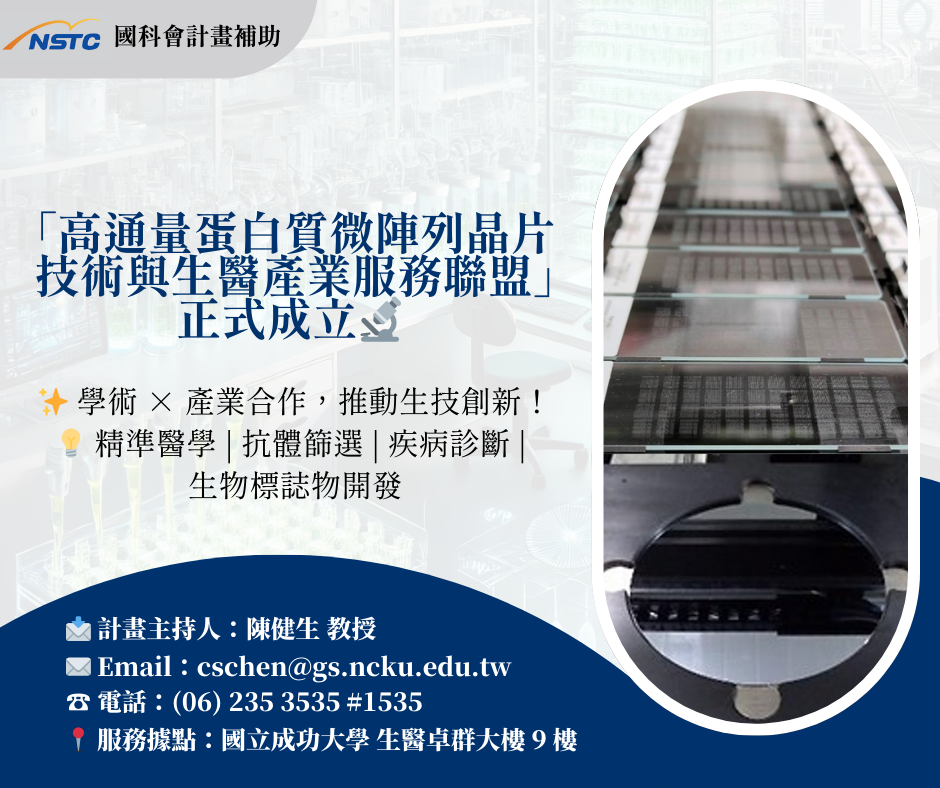
「高通量蛋白質微陣列晶片技術與生醫產業服務聯盟」正式成立!
我們結合 學術研究 × 生醫產業應用,打造台灣最前沿的 高通量蛋白質微陣列技術平台,加速 精準醫學、抗體篩選、疾病診斷、生物標誌物開發 等領域的突破!
聯盟宗旨
- 提供 高通量蛋白質生產純化與微陣列技術,助力臨床研究與生醫產業應用
- 建構血液抗體組生物標誌庫,推動精準診斷與生醫研究發展
- 提供客製化微陣列晶片服務,提升生技產品價值與研發效能
- 產業技術合作:攜手企業開發微陣列新技術與應用
核心服務
- 臨床研究與診斷:疾病生物標誌物篩選,促進精準醫學發展
- 蛋白質微陣列晶片:最先進的全基因體蛋白質微陣列,可在一片晶圓上涵蓋大腸桿菌 4,300 種、酵母菌 5,800 種和人類 21,000 種蛋白質,能精準解析抗體的抗原,促進生物標誌物的發現,並揭示抗體的專一性。
- 藥物標靶分析:開發標靶分析技術,協助藥廠進行新藥開發、作用機制研究、藥物反應預測
- 抗體微陣列晶片:適用於 AKT、MAPK 訊號傳導分析與標誌物研究,涵蓋 300+ 特異性抗體
- 客製化技術服務:提供小規模多重檢測方案,靈活應用於特定標的分析
立即加入聯盟,享專屬技術資源與優惠!
無論你是生醫研究人員、臨床醫師、生技企業、診斷試劑開發商,我們誠摯邀請你加入聯盟會員,掌握前沿技術資源,並享有專屬折扣與技術支援,助你加速研發、提升競爭力!
Email:陳健生教授 cschen@gs.ncku.edu.tw
電話:(06) 235 3535 #1535
服務據點:國立成功大學 生醫卓群大樓 9 樓